Poetry, correspondence, and drawing intergenerational lines
Originally posted Jan 18, 2024 (Substack newsletter)
My grandmother wrote letters. I have a vivid image of her on Sunday afternoons, the tatty flaps of opened envelopes sticking out of a shoebox in front of her on the table in Tallmadge, Ohio, everything glowing with winter light from the south-facing front window. I can smell the kitchen and hear baseball broadcast from the living room. The family was big, my father was the youngest and my grandparents seemed very old by the time I came along. I never really knew them as individuals, only roles, figures moving above me, talking and tending.
My family moved 30 miles west when I turned five, but for years we drove back east for Sunday morning church, spent the midday visiting friends or relaxing at the house my grandfather built on Northeast Avenue, attended evening services, and drove home to the farm. In my memory those miles are dark, cold, nestled into blankets and sheepskins on a vinyl backseat with my next younger sister, and concluded with pretending to sleep so we could be carried into the house. By the time my youngest sister (also a letter writer) was born, we’d localized and the weekly drives ended.
I never got to read my grandmother’s letters to know any details, but I know she wrote to siblings and others who lived near Lake Erie, and she must have written to her children in Florida and California. I know she graduated at the top of her high school class and started then stopped at Ohio Northern University, but other than her handwritten valedictorian speech and an ornamental spoon with the Ada, Ohio skyline, that history was subsumed by birthing five unruly sons and one toughened daughter amid the quotidian necessities prescribed to and dominating women of her time.
I wrote a poem that hits and memorializes some of these notes—
Mary Susan, Writer

She’s still right where I left her in incandescent
light over creamy plastic lace at the dining room table

pushed against a wall under the window
opposite the buffet stacked and loaded with papers,

envelopes, and stationery, not linens.  There are
books, but not so many, in this house where tankards

of golf pencils and swizzle sticks hunker on shelves
among knickknacks and bowling trophies.  Always

the smell of bacon grease. She can see from there
to W.D. in his chair, baseball on television, volume

down, same game as the radio, oily plate on a TV
tray at his right hand, nicked knuckles.  Forever

near the kitchen, chair angled toward it, she turns
her face to the window, down the driveway and road.

She opens a pen, but then gets up to butter saltines,
to lug blocks from the attic, to baste, to stir, to coat

with crumbs, then back to the letters, torn
tops ruffled, first class stamps, the handwriting a sampler

of threadlike blue, cancellation marks
from everywhere else. When at last she settles to write

her reply, first she lifts me to her lap. I follow
the pen and finger pale blossoms that drench her page.
The last stanza might be more wishful thinking than memory. I can’t actually say whether she ever pulled me onto her lap. Mostly I was on the floor teaching myself storytelling and architecture, how events and space flow through rooms, with the hodgepodge of wooden blocks, edges softened by the play of 18 cousins before me, remnants of Grandpa’s carpentry business. Those, I inherited.
But the poem brings me to another letter writer bent over another kind of work. It’s me (predictably) and I’m six in Miss Cartmel’s first grade classroom where I very quickly had worked out reading and was hard at work on tracing out individual letters, lightly tattooed onto pulpy worksheets so I could make my own bolder lines. Again and again, cultivating craft, repeating forms with the same dedication as a Japanese apprentice potter making hundreds of the same cup until the master approves one, I drew them out. Miss Cartmel wasn’t so demanding, but I was a determined young calligrapher and something intensely valuable (I didn’t know what) was at stake in the training of my young, pliable muscles and bones.
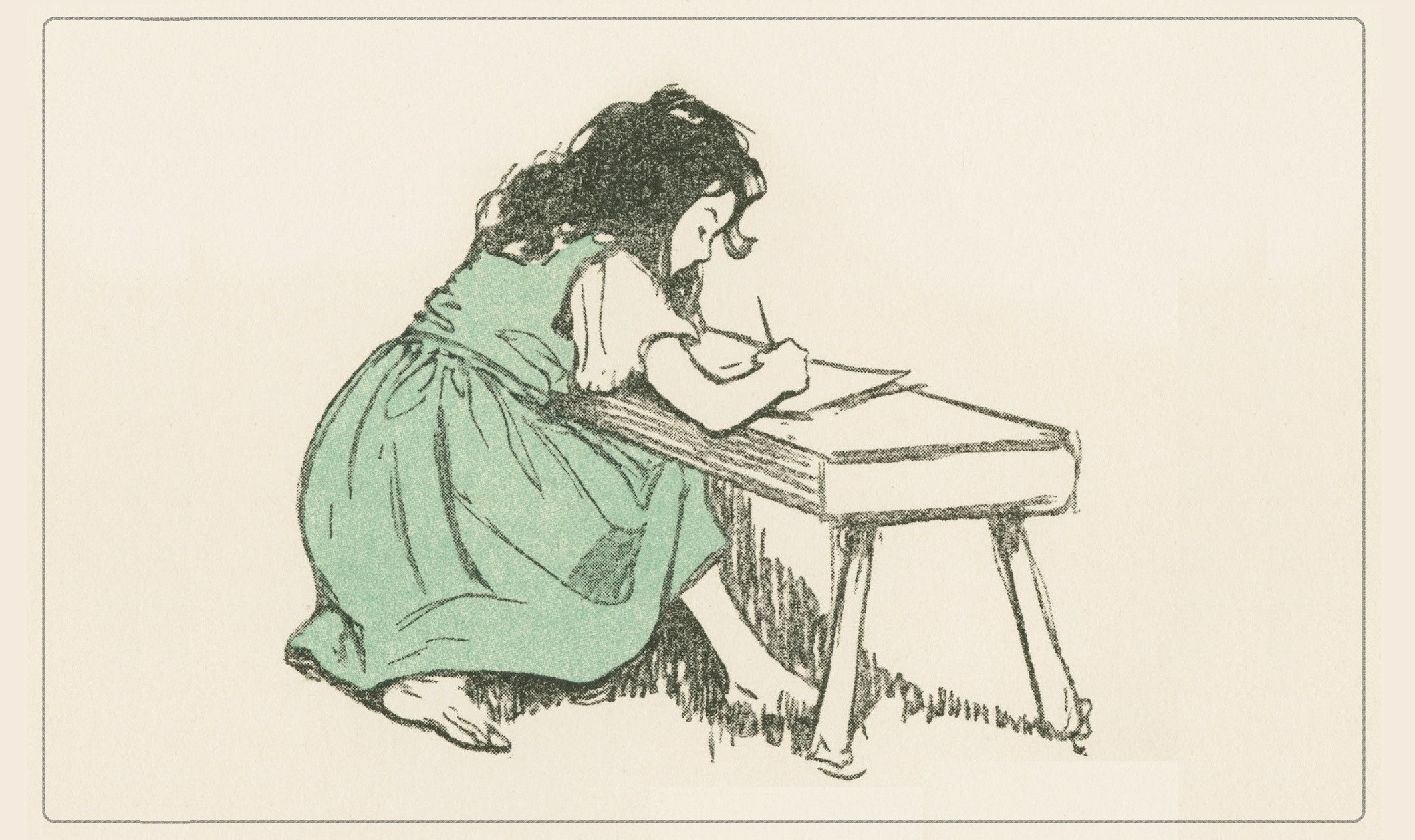
The need to get it just right works both for and against me. Too tight, too judgy, and I get nothing done. But refinement gives me giddy joy.
I made a new friend recently who is a letter writer, and though our correspondence so far has been digital and brief, I got her address and have high hopes. My love of letters, both sorts, swells again as it does on a day of good handwriting (more powerful than a good hair day!), discovery of a new font, anything at all in the physical mailbox, reading about fellow writers writing. Not long ago, I drew an alphabet, each letter entirely unique (including the bonuses that come with Danish and German), and turned it into a coloring book, got a copy for myself, and colored it in.
We get to be writers however we do. There’s no ideal. I don’t know whether my grandmother ever thought of herself as a writer, but she certainly helped spawn the likes of me.
So often I get that urge to write real letters—not just the ones composing themselves in my mind. First, because real letters get far more responses than brainwave ones, but also for the pleasure of crafting ideas into forms, just like any other sort of writing but with a specific heart in mind. The latest gorgeous sample comes from a writer I admire, Sonya Huber, who posted a beautiful piece including a letter she wrote to her nephew. It inspired me to get these thoughts down.
And (sales pitch alert) if you’re looking for yet more inspiration to do some letter writing of your own, The Daily Lines 2024 for writers has letter and postcard writing as its theme. Writing prompts and exercises include springboards about letter writing, and a good number of the almanac entries mention historic letter writers and points, some quirky, of postal history.